
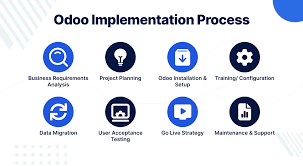
Every ERP journey begins with ambition and a quiet fear of things going sideways. ERP implementation is not a simple upgrade. It is a business shakeup that exposes gaps that were comfortably ignored. When handled well, it delivers real returns.
When handled poorly, it turns into a costly lesson that keeps showing up in reviews. Execution quality decides everything. A structured path for Odoo Implementation Services keeps the process grounded and prevents chaos from taking the wheel.
The guide presents its steps in a way that enables better decision-making, since the resulting decisions pose less danger to the user. The map shows practical routes, while shortcuts create dangerous paths that waste the user’s time, money, and energy.
Step 1: Defining business objectives and success metrics
Step 1 begins by setting clear business objectives so the Odoo Implementation Services journey stays focused and supports growth, efficiency, and cost control. The next move is to define measurable KPIs that show real progress, because vague targets often turn into expensive stories nobody wants to own.
The budget scope is then locked in with discipline so it does not slowly spiral out of control and drain resources.
At the same time, leadership alignment is secured early because disagreements later can derail even the best plans. When everyone is on the same page from the start, the project moves forward with clarity instead of turning into a well dressed chaos.
Step 2: Conducting requirement discovery and process mapping
Peeling back the layers of daily operations often reveals more drama than expected, and Step 2 is exactly where that truth surfaces. A thorough process audit examines how work truly flows on the ground, rather than how it appears in presentations.
Pain analysis then calls out inefficiencies that have been quietly tolerated for years. Gap mapping highlights where systems fall short and where expectations outpace reality.
From here, future workflows are carefully designed to reduce friction and bring order to the madness. This is where Odoo Implementation Services steps in with purpose, turning scattered processes into a system that finally behaves as it was meant to.
Step 3: Selecting the right Odoo implementation partner
Choosing the wrong partner at this stage is like hiring a pilot who has only read about flying, and Step 3 ensures that mistake never happens. A careful vendor shortlist is created based on proven enterprise experience rather than polished sales pitches.
Capability review then digs deeper to check if the partner can actually deliver under pressure and not disappear when things get messy. Industry fit matters because generic solutions often create more problems than they solve. Contract models are evaluated with clarity, so expectations are set without hidden surprises. Strong Odoo Implementation Services partners focus on long-term scalability and support because short-term fixes usually come back to bite.
Read Also: https://www.biztechcs.com/blog/6-ways-an-odoo-partner-reduces-your-erp-migration-risks/
Step 4: Designing solution architecture and system blueprint
A solid system never starts with coding excitement but with a blueprint that quietly decides success or failure, and Step 4 is exactly that moment of truth. Business requirements are shaped into a clear solution architecture so every module mapping has a purpose, and no feature exists just to look busy.
Integration design ensures Odoo connects smoothly with existing systems because disconnected platforms create confusion faster than they solve problems. Data structure is defined with precision, so information remains clean and useful.
Security planning is addressed early because ignoring it now is like leaving the front door open and hoping nothing goes missing.
Step 5: Executing customization and development
The upcoming section introduces assessment methods for determining an idea’s value, and Step 5 enables users to create customized solutions through active development. The system develops features that meet actual business requirements, so staff members can use the system without having to adapt their workflows.
Workflow logic is configured to maintain operational consistency and reduce manual chaos. Automation setup removes repetitive work that quietly eats time every day. Performance tuning ensures the system runs smoothly without testing everyone’s patience.
At the same time, over-customization is kept in check because turning Odoo Implementation Services into a science experiment usually ends in regret.
Step 6: Managing enterprise data migration
Buried in years of operations lies data that can either support the system or quietly destroy it, and Step 6 deals with that reality head-on. A detailed data audit identifies what is useful and what should have been deleted long ago. Cleansing rules are applied to remove errors and duplicates because messy data has a tendency to break even the best systems.
Migration tools are selected carefully to move information without losing context. Validation checks confirm accuracy, so nothing important goes missing. Odoo Implementation Services ensure legacy data enters the new system clean and secure because garbage in still means disaster out.
Step 7: Performing testing and validation
The system must demonstrate its ability to handle actual operational tasks before launch, as Step 7 establishes security measures to protect all content. Functional testing verifies that all functions operate as expected, without introducing unexpected results. Integration testing confirms that different systems maintain real communication rather than simulate collaboration.
User acceptance testing brings business teams into the picture, so real-world scenarios are validated rather than just technical assumptions. Issue tracking captures every flaw because ignoring small problems now is like planting future disasters. Odoo Implementation Services rely on this step to confirm that the system is ready, not just looking ready.
Step 8: Deploying the system and enabling adoption
The moment of truth arrives when the system leaves planning decks and enters real operations, and Step 8 ensures that the jump does not turn into chaos. A clear deployment plan guides the go-live, so nothing is left to guesswork. Rollout phases are structured to reduce risk because flipping everything at once is a bold move that rarely ends well. User training prepares teams to actually use the system rather than fight it daily. Change management keeps resistance in check because people do not magically love new systems overnight. Odoo Implementation Services focus on adoption, ensuring the system works in practice, not just on paper.
Step 9: Optimizing performance and scaling after go-live
What happens after go-live often determines whether the system becomes an asset or an ongoing headache that refuses to go away. KPI tracking maintains continuous monitoring of business performance, enabling precise measurement of operational results rather than relying on assumed outcomes.
The system undergoes continuous improvement because its operational requirements evolve, whereas the system needs to avoid becoming outdated too soon. System scaling enables organizations to expand their operations without experiencing performance declines or system failures during peak demand.
A reliable support model handles issues before they grow into larger problems. Odoo Implementation Services focus on refining and stabilizing the system so that it continues to deliver value long after the initial excitement fades.
Conclusion
Nine steps later, the difference between a controlled transformation and a corporate horror story becomes painfully clear, and the outcome rarely lies in the effort put in. A structured approach to Odoo Implementation Services keeps decisions sharp and prevents the project from turning into an endless repair job.
Strong leadership alignment throughout the journey ensures priorities stay intact and distractions stay out. Long-term value and ROI do not arise by chance; they are built through discipline at every step.
The smart move is to partner with experienced professionals because guessing through implementation is a gamble that usually collects its dues without mercy.